
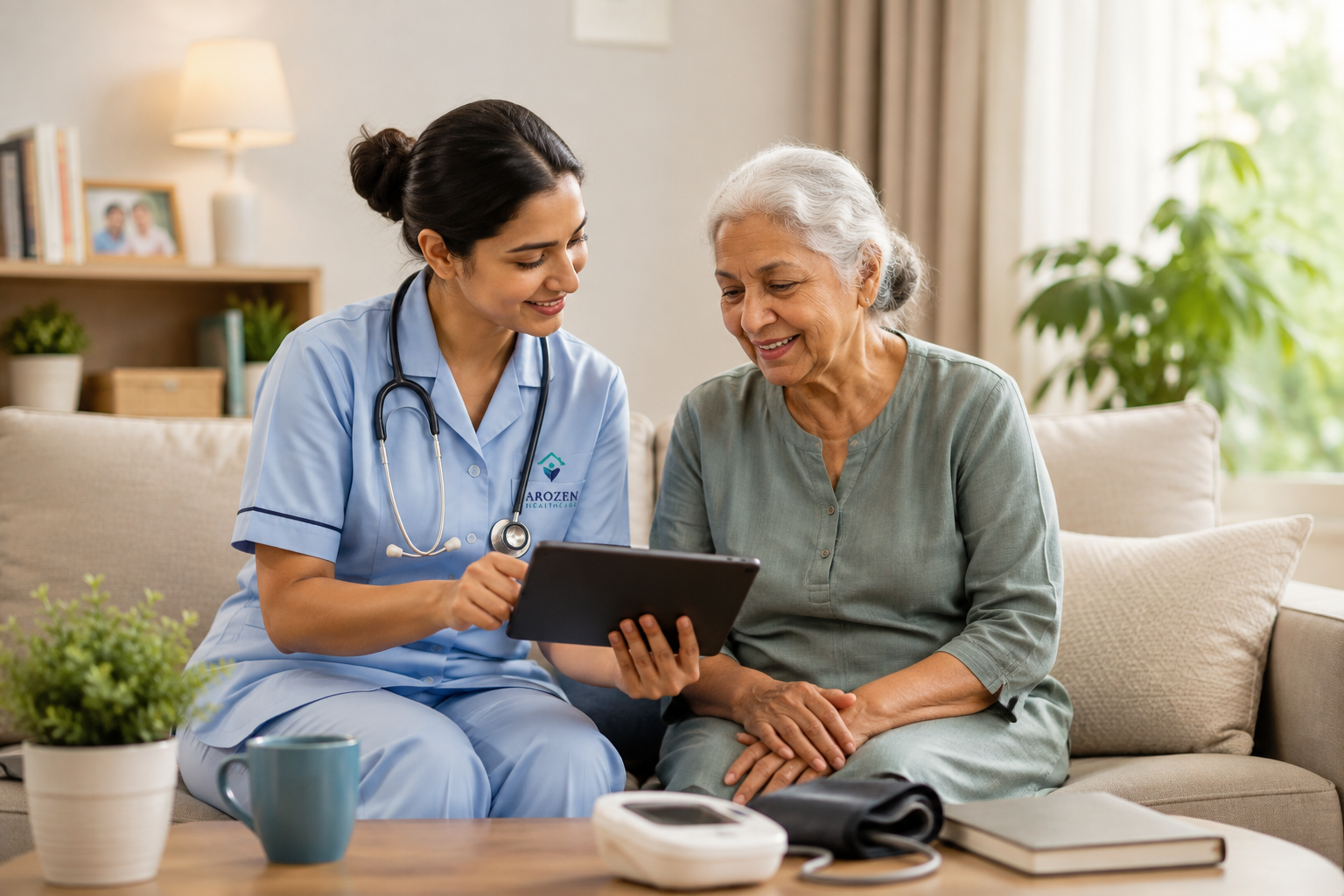
Home healthcare means receiving appropriate medical or care support in your own home, instead of at a hospital or clinic, for situations where that's clinically appropriate. More families in Gurugram have started exploring healthcare at home in recent years — often because a loved one is recovering from a procedure, managing an ongoing condition, or simply finds regular clinic visits difficult.
Arozen Healthcare provides home healthcare in Gurugram, connecting families with qualified professionals for a range of home-based services. This guide walks through what home healthcare actually involves, who it tends to suit, and what to look for when choosing a provider.
What Is Home Healthcare?
Home healthcare refers to professional medical or clinical support delivered at a patient's home by trained healthcare providers — doctors, nurses, physiotherapists or other qualified professionals — rather than informal, non-clinical help.
It's different from ordinary caregiving. A caregiver typically assists with everyday activities like meals, mobility and companionship. Home healthcare can additionally include clinical elements — monitoring a patient's condition, supporting prescribed treatment, or assisting recovery under a doctor's guidance — depending on what's actually needed.
What a family needs can vary a great deal. Some households need occasional doctor home visits; others need daily nursing support or ongoing caregiver assistance. Home healthcare services are generally shaped around the patient's specific condition and clinical requirements, not a single fixed package.
Why Choose Healthcare at Home?
For many families, healthcare at home offers practical advantages over repeated hospital or clinic visits:
- Comfort of Familiar Surroundings
- Receiving care at home means staying in a familiar, comfortable environment rather than an unfamiliar clinical setting.
- Reduced Travel Burden
- There's no need to arrange transport or navigate traffic for every appointment, which matters when travel itself is difficult.
- Helpful for Elderly or Mobility-Limited Patients
- For seniors or anyone with limited mobility, home-based care avoids the physical strain of frequent clinic visits.
- Family Involvement
- Family members can stay closely involved in day-to-day care, ask questions directly, and stay informed about progress.
- Convenient Recovery Support
- Patients recovering from a procedure or illness can continue their recovery at home, with support built around their routine.
- Continuity of Appropriate Care
- Where clinically appropriate, follow-up visits and ongoing support can continue in the same familiar setting.
What Home Healthcare Services Can Include
Arozen Healthcare offers a range of home healthcare services in Gurugram, each shaped around individual patient needs:
- Doctor home visits for consultations, assessments and prescriptions at home.
- Home nursing care for medication support, monitoring and clinical assistance.
- Caregiver support for daily assistance, mobility and companionship.
- Physiotherapy at home for movement-based recovery and rehabilitation.
- Elderly care for everyday support tailored to seniors.
- Patient care at home for patients with limited or no mobility.
- Wound dressing for professional wound care and monitoring.
- Catheter care and Ryle's tube care for ongoing clinical support.
- Lab sample collection and other appropriate diagnostic support, such as ultrasound services, at home.
Who Can Benefit From Home Healthcare?
Home healthcare can be a practical option for a range of situations, including:
- Elderly people who prefer to receive care in a familiar environment
- Patients recovering after hospitalisation who need ongoing monitoring or support
- People with mobility limitations who find regular clinic visits difficult
- Patients needing ongoing, routine support for an existing condition
- Families who need professional care assistance alongside their own caregiving
Home healthcare isn't automatically the right fit for every medical situation. Suitability depends on the specific condition, the treatment involved and a proper clinical assessment — not every case can, or should, be managed at home. For a closer look at specific situations, see our related guides on home nursing care and elderly care at home.
How to Choose a Home Healthcare Provider in Gurugram
Choosing a home healthcare provider is worth doing carefully. A few things genuinely matter:
- Qualified Healthcare Professionals
- Confirm that the doctors, nurses or caregivers involved are appropriately qualified for the type of support being provided.
- Clear Service Scope
- A good provider should be clear about exactly what's included in the service, and what isn't.
- Care Planning
- Care should be planned around the patient's actual condition, not a generic, one-size-fits-all routine.
- Communication With Family
- Families should be kept informed and able to ask questions about the care being provided.
- Safety and Hygiene Practices
- Basic safety and hygiene standards should be followed consistently, for every visit.
- Transparent Process
- Pricing, scheduling and what to expect should be communicated clearly, without surprises.
- Appropriate Escalation to Hospital or Doctor
- A responsible provider should recognise when a situation needs to be escalated to a hospital or the treating doctor, rather than continuing to manage it at home.
Home Healthcare vs Hospital Care
Home healthcare is a valuable option for a wide range of everyday and recovery-related needs — but it does not replace emergency or hospital care. It's designed to support ongoing, non-emergency care in a home setting, under appropriate clinical guidance.
When Urgent or Emergency Care Is Needed
If a patient is experiencing a medical emergency, a sudden severe symptom, or a condition that needs immediate clinical evaluation, hospital or emergency care should be sought right away rather than home-based support.
Why Local Care Matters in Gurugram
Working with a home healthcare provider based in Gurugram has some practical benefits. Coordination tends to be easier when visits, scheduling and follow-ups are handled locally. A locally active provider is also more likely to understand the kind of day-to-day support families in the area actually ask for, and can typically arrange home visits more conveniently than a provider working from further away. Clear, ongoing communication with the family also tends to be easier to maintain when care is coordinated locally.